English
  français
  Deutsch
  русский
  español
  português
  العربية
  Melayu
  ไทย
ไทย  Indonesia
  हिंदी
हिंदी 


Sie müssen Hersteller von Aluminiumprofilen vor der Unterzeichnung von Lieferverträgen systematisch bewerten. Die Sicherstellung hoher Qualität und langfristiger Zuverlässigkeit erfordert die Prüfung der betrieblichen Fähigkeiten neben den technischen Produktstandards. Überprüfen Sie zunächst Fabrikzertifizierungen, automatisierte Technologien, Produktionsausrüstung und Anlagenkapazität. Jeder kompetente Hersteller von Aluminiumextrusionen erfüllt strenge betriebliche Richtlinien. Zweitens prüfen Sie die physische Produktion direkt. Sie müssen die Legierungsreinheit, Maßtoleranzen, Oberflächenbeschichtungsdicke und strukturelle Festigkeit verifizieren. Ein qualifizierter Hersteller von Aluminiumextrusionen liefert durchgehend hochwertige industrielle Aluminiumprofile. Die gründliche Bewertung jedes Herstellers schützt Ihre Strukturprojekte vor kostspieligen Betriebsausfällen. Die Wahl des richtigen Herstellers von Aluminiumprofilen garantiert den vollständigen Projekterfolg.
Wichtige Erkenntnisse
-
Prüfen Sie die ISO-Zertifizierungen der Fabrik und moderne Ausrüstung, um höchste Fertigungsstandards sicherzustellen.
-
Verifizieren Sie die Reinheit der Aluminiumlegierung und die Maßgenauigkeit mithilfe präziser Laborprüfgeräte.
-
Prüfen Sie die Dicke der Oberflächenbeschichtung, um Aluminiumprofile vor Schäden durch raue Wetterbedingungen zu schützen.
-
Testen Sie die Metallhärte und Zugfestigkeit, um eine hohe strukturelle Belastbarkeit zu gewährleisten.
Prüfung der betrieblichen Fähigkeiten von Herstellern von Aluminiumprofilen
Sie müssen die Fabrikinfrastruktur prüfen, bevor Sie Ihre Liefervereinbarung abschließen. Führende Hersteller von Aluminiumprofilen arbeiten unter strengen internationalen Rahmenbedingungen und setzen hochwertige Technologien ein. Jeder qualifizierte Hersteller von Aluminiumextrusionen stellt transparente Dokumentationen zur betrieblichen Effizienz bereit. Diese Prüfung hilft Ihrem Beschaffungsteam, industrielle Aluminiumprofile für anspruchsvolle strukturelle Anwendungen zu bewerten. Sie können Ihr Unternehmen vor kostspieligen Projektverzögerungen schützen, wenn Sie einen erfahrenen Hersteller auswählen.
Wichtige Prüfungserkenntnis: Der Betrieb automatisierter Pressen mit hoher Tonnage unter zertifizierten Prozesskontrollen gewährleistet direkt eine einheitliche Kornstruktur, präzise Geometrie und vorhersehbare Tragfähigkeit in jeder Charge.
Konformitätsstandards und internationale Zertifizierungen
Sie sollten während Ihrer ersten Werksbewertung die Qualitätsmanagementnachweise überprüfen. Sie müssen eine aktive ISO-9001-Zertifizierung verifizieren, um strukturierte Prozesskontrollen über alle Produktionsstufen hinweg zu bestätigen. Eine aktive ISO-9001-Zertifizierung beweist, dass ein Unternehmen systematische Aufzeichnungen führt, Werkzeuge regelmäßig kalibriert und interne Arbeitsabläufe prüft. Sie sollten außerdem CE- und TSE-Zertifizierungen überprüfen, um die Einhaltung globaler Sicherheits- und Fertigungsrichtlinien zu bestätigen. Eine konforme Fabrik eines Herstellers von Aluminiumprofilen setzt konsequent standardisierte Verfahren durch, um Fehlerquoten zu senken.
Tipp: Fordern Sie immer einen direkten Nachweis der ISO-9001-Zertifizierung von der Prüfagentur an, anstatt sich ausschließlich auf Werbebroschüren zu verlassen.
Sie müssen spezielle Zertifizierungen für die Oberflächenveredelung bei Bestellungen von architektonischen Aluminiumprofilen und industriellen Aluminiumprofilen prüfen. Die Qualitätszeichen QUALANOD und QUALICOAT bestätigen strenge Protokolle zum Oberflächenschutz.
|
Zertifizierungsstandard |
Umfang der Oberflächenbehandlung |
Schwerpunkt & Zielanwendungen |
Wesentliche Prüfparameter |
|---|---|---|---|
|
QUALICOAT |
Pulver- oder flüssige organische Beschichtung auf Aluminium |
Hochwertige Schutz- und ästhetische Beschichtungen für architektonische Komponenten (z. B. Türen, Fenster, Fassaden) |
• Schichtdicke |
|
QUALANOD |
Eloxierung (elektrochemische Oxidation) von Aluminium |
Kontrolle der Oxidschichttiefe, Dichtungsintegrität und gleichmäßige Erscheinung |
• Farbfleckprüfung |
Ein zuverlässiger Hersteller von Aluminiumextrusionen setzt strenge Schichtgrenzen durch, um Profile vor Umwelteinflüssen zu schützen:
-
Anforderungen an die Dicke der Eloxalschicht:
-
Innenanwendungen: 5–10 μm
-
Architektonische Anwendungen: 10–15 μm
-
Industrielle / maritime Umgebungen: 20–25 μm
-
-
Anforderung an die Schichtdicke der Pulverbeschichtung: 60–80 μm Standard
-
Vorbehandlung & Kontrolle: Chromatierung oder chromfreie Vorbehandlung, Gitterschnitt-Haftprüfungen, Schlagfestigkeitsprüfung und chargenweise Dickenüberprüfung
Fortschrittliche Extrusionsmaschinen und Automatisierung
Moderne Extrusionsanlagen setzen auf computergesteuerte Ausrüstung, um dynamische Präzision sicherzustellen. Sie müssen die technologischen Investitionen jedes potenziellen Herstellers von Aluminiumextrusionen bewerten. Automatisierte Maschinen beseitigen manuelle Fehler und schützen die Gesamtqualität während intensiver Pressvorgänge.
|
Merkmal / Aspekt |
Automatisierte Extrusionstechnologie |
Manuelle Maschinen |
|---|---|---|
|
Steuerungssystem |
Nutzt Echtzeit-Sensorrückmeldungen in einem geschlossenen Regelkreis, um Parameter wie Stempeldruck, Geschwindigkeit und Matrizen-Temperatur sofort anzupassen. |
Ist auf menschliche Überwachung und manuelle Einrichtung angewiesen und verfügt nicht über kontinuierliche dynamische Echtzeitanpassungen. |
|
Querschnittskonsistenz |
Hält Profile durch automatische Kompensation von Parameterabweichungen ohne Verzögerung innerhalb strenger, enger Toleranzen. |
Anfällig für Abweichungen und Inkonsistenzen aufgrund verzögerter menschlicher Eingriffe und Abhängigkeit vom Bediener. |
|
Betriebsgeschwindigkeit & Genauigkeit |
Die Geschwindigkeit wird dynamisch automatisch korrigiert (z. B. als Reaktion auf Änderungen der Matrizen-Temperatur), um die Profilintegrität zu schützen. |
Anpassungen erfolgen reaktiv, periodisch und weniger präzise, wodurch das Risiko von Profilverformungen steigt. |
Schwere industrielle Aluminiumprofile erfordern robuste Extrusionsmaschinen. Sie müssen die Presskraftkapazität anhand Ihrer strukturellen Konstruktionsspezifikationen überprüfen.
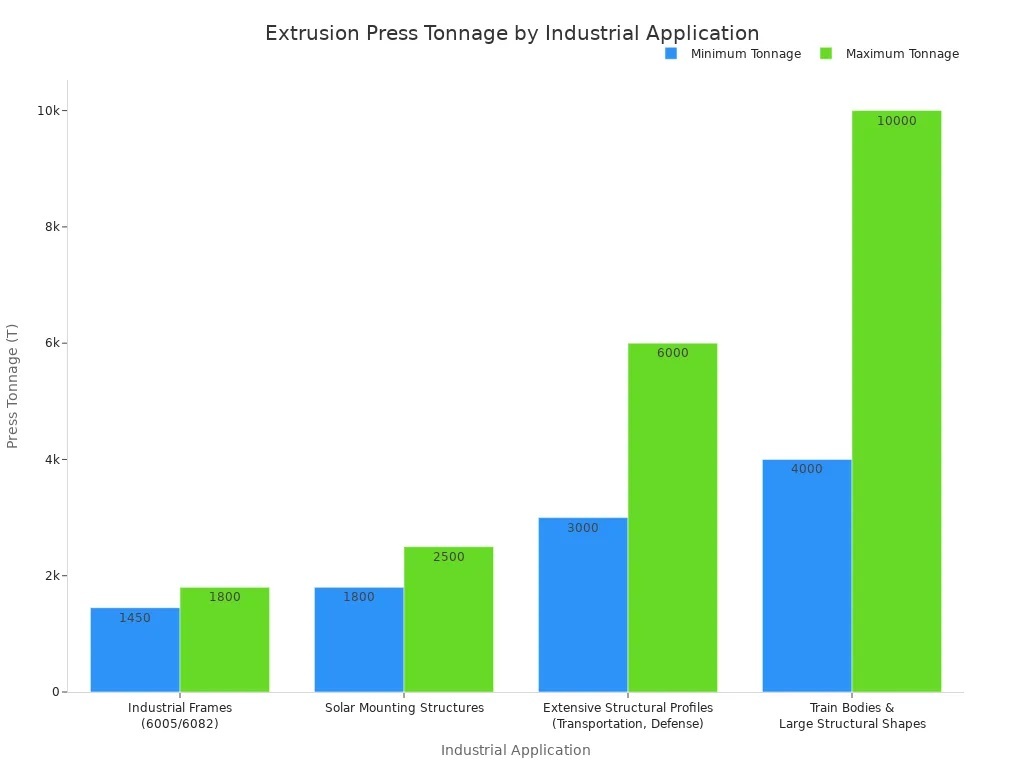
Ein erstklassiger Hersteller von Aluminiumextrusionen betreibt eine Reihe von Pressen, um vielfältige Profilgeometrien herzustellen. Industrielle Rahmenkomponenten erfordern eine Presskraft von 1.450 bis 1.800 Tonnen. Solarmontagesysteme benötigen Presskapazitäten zwischen 1.800 und 2.500 Tonnen. Massive Strukturformen für Transport und Verteidigung erfordern 3.000 bis 6.000 Tonnen. Große Zugkörper benötigen massive Pressen mit 4.000 bis 10.000 Tonnen.
Individuelle Engineering-Kapazitäten bei GUANGYA ALUMINIUM
GUANGYA ALUMINIUM dient als Branchenmaßstab für komplexe Fertigungsanforderungen. Als führender Hersteller von Aluminiumextrusionen verfügt GUANGYA ALUMINIUM über mehr als 70 fortschrittliche Extrusionslinien. Die Presskapazitäten reichen von 600 Tonnen bis zu 5.500 Tonnen. Diese Hochkapazitäts-Pressenlinie bewältigt problemlos komplexe industrielle Sonderaufträge und Standard-Aluminiumextrusionen.
Sie erhalten Zugang zu 200 Sätzen wichtiger Produktionsanlagen, wenn Sie mit GUANGYA ALUMINIUM zusammenarbeiten. Das Ingenieurteam bietet fachkundige Handwerkskunst zur Umsetzung exakter technischer Zeichnungen. Die Fabrik produziert jährlich 500.000 bis 700.000 Tonnen Aluminiumprodukte an ihren wichtigsten Produktionsstandorten.
Ein erstklassiger Hersteller von Aluminiumprofilen muss hohe Produktionsmengen mit flexibler technischer Unterstützung kombinieren. GUANGYA ALUMINIUM vereint Großserienkapazität, kundenspezifisches Werkzeugdesign und strenge Qualitätskontrolle in einem Betriebssystem. Die Auswahl eines etablierten Herstellers von Aluminiumextrusionen minimiert strukturelle Risiken und gewährleistet stabile Lieferketten für jedes größere Projekt.
Bewertung von industriellen Aluminiumprofilen Qualität und Toleranzen
Sie müssen die physische Produktion direkt bewerten, um die strukturelle Integrität zu überprüfen. Führende Anlagen setzen zerstörungsfreie Prüfmethoden (NDT) vor dem Versand fertiger Waren ein. Fortschrittliche Techniker verwenden Ultraschallscanner und Röntgenbildgebung, um innere Hohlräume, verborgene Risse und Einschlüsse zu erkennen. Automatisierte visuelle Inspektionssysteme prüfen während der Produktion kontinuierlich jede Außenfläche. Diese optischen Sensoren erkennen sofort kleine Kratzer, Matrizenlinien und Mikrorisse. Die Kombination aus zerstörungsfreier Prüfung und strengen Qualitätskontrollprotokollen verhindert, dass fehlerhafte Teile Ihre Montagelinie erreichen. Jeder zuverlässige Hersteller von Aluminiumextrusionen führt diese ersten Prüfungen durch, um die strukturelle Sicherheit zu gewährleisten.
Prüfpriorität: Zerstörungsfreie Ultraschallprüfung und automatisierte visuelle Bildgebung beseitigen verborgene interne Hohlräume, bevor Ihr Team dauerhafte zerstörende Materialprüfungen durchführt.
Legierungsauswahl und Überprüfung der chemischen Zusammensetzung
Sie müssen die elementare Reinheit bestätigen, bevor Sie Serienproduktionslieferungen akzeptieren. Die Prüfung der chemischen Zusammensetzung verwendet optische Emissionsspektrometer und Laboranalysen vor der Produktion und dem Versand. Techniker messen und bestätigen die genauen Anteile von Elementen wie Magnesium, Silizium und Eisen. Statt die absolute Reinheit zu prüfen, stellt dieser Prozess sicher, dass das Material die exakten Kriterien für die prozentuale Elementzusammensetzung einhält, die für Standardlegierungen der Typen 6061 und 6063 erforderlich sind.
Ein erfahrener Hersteller von Aluminiumextrusionen zertifiziert die chemische Zusammensetzung für jede Schmelzcharge. Geeignete Elementverhältnisse gewährleisten eine ideale Wärmebehandlungsreaktion und langfristige mechanische Leistung. Sie schützen Ihre strukturellen Anwendungen, indem Sie zertifizierte spektrografische Prüfberichte für alle industriellen Aluminiumprofile verlangen.
Prüfung der Maßgenauigkeit und Wandstärke
Sie müssen über jeden kundenspezifischen Extrusionsquerschnitt hinweg eine strenge Maßgenauigkeit sicherstellen. Hochgeschwindigkeits-Montagesysteme erfordern enge Geometrien und gleichmäßige Wandstärken. Standardmäßige kommerzielle Extrusionen weisen häufig Maßabweichungen auf, die zu Installationsfehlern führen.
Sie können strenge Toleranzparameter überprüfen, indem Sie die Lieferantenergebnisse mit etablierten Industriestandards vergleichen:
|
Profilkategorie / Vorgang |
Abmessungstyp |
Anwendbare Toleranz |
|---|---|---|
|
Standards für Profilanwendungen |
Präzision / Ultra-Präzision |
Reicht je nach Anwendung (z. B. Luft- und Raumfahrt, Kühlkörper) von der Präzisions- bis zur Ultra-Präzisionsklasse |
|
Typische Nachbearbeitung nach CNC-Bearbeitung |
Lineare Abmessungen |
±0,05 mm bis ±0,10 mm |
|
Fein-/Hochpräzisionsbearbeitung |
Ausgewählte Merkmale |
±0,02 mm |
Präzise Ausrichtungsanforderungen erfordern eine strenge Überprüfung der Wandstärke. Ein kompetenter Hersteller von Aluminiumprofilen durch Extrusion verwendet digitale Messschieber und optische Komparatoren, um die Querschnittsgeometrie zu überprüfen. Sie gewährleisten eine nahtlose Montagequalität, wenn Ihr Lieferant kontinuierlich eine hohe Maßgenauigkeit liefert. Einkaufsmanager sollten beim Bestellen komplexer industrieller Aluminiumprofile genaue Toleranzklassen festlegen.
Schichtdicke und Gleichmäßigkeit der Oberflächenbehandlung
Sie sollten jede Schicht der Oberflächenbehandlung prüfen, um eine umweltbedingte Verschlechterung zu verhindern. Eloxierte Schichten und Pulverbeschichtungen schützen den Metallkern vor aggressiven atmosphärischen Einflüssen. Ein diszipliniertes Qualitätskontrollsystem misst die Beschichtungsdicke an mehreren Kontaktpunkten.
Bei starker äußerer Beanspruchung müssen Sie spezielle Anforderungen an die Eloxierungstiefenwerte stellen:
-
Anforderungen der CA-1-Klassifizierung:
-
Zielwert der eloxierten Schicht: 15–20 Mikrometer
-
Empfohlene Umgebungen: Starke Niederschläge, hohe Luftfeuchtigkeit, Küstenentwicklungen und Hochhausfassaden
-
Primärer Schutzzweck: Hervorragender UV-Schutz und langfristige Korrosionsbeständigkeit
-
Unterschiedliche Einsatzumgebungen erfordern angepasste Protokolle zum Oberflächenschutz:
|
Umweltbelastung |
Empfohlene Beschichtungsdicke |
Primärer Schutzzweck |
|---|---|---|
|
Hohe Beständigkeit / Außenbereichseinsatz |
20–25+ Mikrometer |
Beständigkeit gegen Witterungseinflüsse und industrielle Verschmutzung |
|
Küstenbereich, Marine & hohe Luftfeuchtigkeit |
25–30 Mikrometer |
Hervorragender Schutz gegen Salzwasser, Feuchtigkeit und extreme Korrosion |
Anwendungen mit Pulverbeschichtungen erfordern dieselbe analytische Präzision. Sie müssen fertige Chargen mithilfe standardisierter physikalischer Prüfverfahren auditieren:
|
Prüfparameter |
Ausrüstung / Standardmethode |
Akzeptanzkriterien / Beschreibung |
|---|---|---|
|
Schichtdicke |
Kalibriertes Schichtdickenmessgerät (elektromagnetischer Induktionstyp) |
Gemessen mit Präzisionsausrüstung statt durch Sichtprüfung, um die Zielschichtdicke sicherzustellen. |
|
Gitterschnitt-Haftfestigkeit |
ASTM-D3359-Standardprüfverfahren |
Erfordert das Einschneiden der Oberfläche, das Aufbringen und Abziehen von Klebeband, wodurch minimale Abplatzungen entstehen (Bewertung 4B oder 5B, wobei 5B für Außenanwendungen erforderlich ist). |
-
Anforderungen der Qualicoat-Klasse 1: Normen für die architektonische Aluminiumveredelung schreiben eine minimale Schichtdicke von 60 µm vor.
-
Haftfestigkeitsbewertung: Muss gemäß dem ISO-2409-Gitterschnitt-Haftungsstandard eine Klassifizierung mit Bewertung 0 erreichen.
Ein Hersteller von erstklassigen Aluminiumprofilen unterhält aktive Flüssigbeschichtungslinien neben Eloxierbädern. Die Prüfung dieser Schutzschichten stellt sicher, dass Ihre Bestellungen von industriellen Aluminiumprofilen und Architektur-Aluminiumprofilen rauen Witterungsbedingungen im Außenbereich standhalten. Eine hochwertige Oberflächenveredelung verlängert die Produktlebensdauer erheblich.
Prüfung der mechanischen Eigenschaften von industriellen Aluminiumprofilen
Sie müssen zerstörende Materialprüfungen vorschreiben, um die innere Strukturfestigkeit zu überprüfen. Physische Belastungstests bestätigen, ob die Wärmebehandlungszustände den technischen Projektspezifikationen entsprechen.
Die Webster-Härteprüfung liefert sofortige Rückmeldung über die Qualität der Wärmebehandlung des Zustands:
|
Zustand |
Webster-Härtebereich |
Streckgrenzenanforderung |
|---|---|---|
|
6063-T5 |
8–11 HW |
— |
|
6063-T6/T66 |
10–13 HW |
— |
Die Streckgrenzenprüfung ermittelt die tatsächlichen Belastungsgrenzen:
|
Zustand |
Mindeststreckgrenze (Rp0.2) |
Typische Hinweise zu Härte / Festigkeit |
|---|---|---|
|
6063-T5 |
≥110 MPa |
Mindestens ≥8 HW (typischerweise tatsächliche Streckgrenze von 130–150 MPa) |
|
6063-T6 |
≥180 MPa |
Standard mit höherer Festigkeitsanforderung |
Die zerstörende Zugprüfung verifiziert die maximale Zugfestigkeit von Profilen, indem eine vorbereitete Metallprobe in eine Universalprüfmaschine (UTM) eingesetzt wird. Die Vorrichtung klemmt beide Enden der Probe ein und übt durch das Auseinanderbewegen der Traversen mit einer geregelten Geschwindigkeit eine kontinuierlich ansteigende einachsige Zugkraft aus. Dabei werden Belastung und Dehnung präzise verfolgt, bis ein vollständiger Strukturbruch eintritt.
Sie sollten den genauen Ablauf der Zugprüfung überprüfen:
-
Entnahme und Vorbereitung der Probe: Standardisierte "Hundeknochen"-Prüfproben oder bearbeitete Stäbe werden direkt aus dem extrudierten Profil entsprechend der festgelegten Messlänge und Querschnittsabmessungen entnommen.
-
Montage der Vorrichtung: Die vorbereitete Probe wird in hydraulischen Spannbacken innerhalb einer dafür vorgesehenen Zugprüfvorrichtung (wie Instron- oder Zwick-Geräten) befestigt.
-
Kontrolliertes Ziehen: Mechanische Kraft wird angewendet, um die Probe mit einer festen Dehnungsrate zu ziehen. Dabei werden Spannungs-Dehnungs-Daten kontinuierlich bis zum Fließen und zum mechanischen Versagen/Bruch aufgezeichnet.
-
Bestimmung der Eigenschaften: Wichtige mechanische Kennwerte werden aus der aufgezeichneten Datenkurve ermittelt, insbesondere die maximale Zugfestigkeit (UTS) als die höchste vor dem Bruch ertragene Spannung sowie Streckgrenze (0,2%-Dehngrenze) und Duktilitäts-/Dehnungsprozentsätze.
-
Überprüfung der Normkonformität: Das Verfahren entspricht festgelegten industriellen Prüfstandards, einschließlich ASTM B557 und ISO 6892, um Strukturqualität, Wärmebehandlung und Legierungszustand zu bestätigen.
Umfassende Materialprüfungen belegen, dass Ihre industriellen Aluminiumprofile kritische dynamische Belastungen tragen können. Ein leistungsfähiger Hersteller von Aluminiumprofilen unterhält direkt vor Ort kalibrierte Prüflabore. Die Integration kontinuierlicher Qualitätskontrollen bei Rohmaterialauswahl, Extrusion, Oberflächenveredelung und mechanischer Prüfung gewährleistet außergewöhnliche Produktqualität für jeden schweren Strukturbauauftrag.
Aufbau von Zuverlässigkeit und langfristiger Lieferantenleistung
Sie müssen langfristigen operativen Erfolg sichern, indem Sie die Lieferantenkonsistenz überprüfen. Ein zuverlässiger Lieferant von Aluminiumprofilen liefert gleichmäßige Teile über alle Produktionschargen hinweg. Sie schützen Ihr Unternehmen vor Lieferunterbrechungen, wenn Sie mit einem geprüften Hersteller von Aluminiumprofilen zusammenarbeiten.
Strategie für Beschaffungsaudits: Regelmäßige stufenweise Fabrikinspektionen gewährleisten eine stabile Produktion, verringern Fehlerrisiken und verbessern das Lieferkettenmanagement.
End-to-End-Qualitätskontrolle und Stufenaudits
Sie sollten bewerten, wie ein Hersteller von Aluminiumprofilen den täglichen Betrieb kontrolliert. Ein qualifizierter Hersteller von Aluminiumprofilen setzt strenge Qualitätskontrollverfahren von der Erwärmung der Rohbolzen bis zur abschließenden Wärmebehandlung um.
|
Fertigungsstufe |
Qualitätskontrollpunkte |
|---|---|
|
Prüfung und Erwärmung von Rohbolzen |
• Chemische/Legierungszusammensetzung überprüfen |
|
Einrichtung und Durchführung der Extrusion |
• Zustand der Matrize prüfen und Presseeinstellungen validieren |
|
Abschrecken und Strecken |
• Ausreichende Abkühlrate überprüfen |
|
Alterungsofenprozess |
• Härte- und Zustandsprüfung durchführen |
Eine strenge Qualitätskontrolle gewährleistet die mechanische Integrität industrieller Aluminiumprofile. Jeder erfahrene Hersteller von Aluminiumstrangpressprofilen verfolgt diese wichtigen betrieblichen Schritte genau.
Stabilität der Lieferkette und Management der Lieferzeiten
Sie müssen die Lieferfristen bewerten, bevor Sie Bestellungen für industrielle Aluminiumprofile aufgeben. Zuverlässige Lieferpläne verhindern Ausfallzeiten in Ihrer Hauptfabrikproduktion. Sie können Leistungsbenchmarks festlegen, indem Sie potenzielle Lieferanten anhand der branchenüblichen Lieferzeiten bewerten.
|
Phase / Bestellkomplexität |
Richtwert für die Lieferzeit |
|---|---|
|
Erstellung und Validierung von Werkzeugen |
Fügt 1 bis 4 Wochen hinzu (bis zu 2 bis 6 Wochen vor der vollständigen Produktion) |
|
Kleines Volumen und einfaches Profil |
4 bis 8 Wochen nach der Werkzeugfreigabe |
|
Mittleres Volumen und Standardprofil |
6 bis 10 Wochen nach der Werkzeugfreigabe |
|
Großes Volumen und mittlere Komplexität |
8 bis 12 Wochen nach der Werkzeugfreigabe |
|
Neue Werkzeuge und komplexes Profil |
10 bis 14+ Wochen insgesamt |
Ein erfahrener Hersteller von Aluminiumstrangpressprofilen hält Rohaluminiumvorräte bereit, um Lieferzeiten zu verkürzen. Die Bewertung der Termineinhaltung gewährleistet die allgemeine Zuverlässigkeit der Lieferkette.
Checklisten für Vor-Ort-Audits und Lieferantenbewertung
Sie sollten strukturierte Werksaudits durchführen, bevor Sie Hersteller von Aluminiumprofilen auswählen. Ein führender Hersteller von Aluminiumprofilen begrüßt eine transparente betriebliche Bewertung während der Lieferantenprüfungen.
Ihr Team muss diese kritischen betrieblichen Kategorien prüfen:
-
Lieferanteninformationen und Hintergrund: Bewertung der grundlegenden Unternehmenseigentumsverhältnisse, des Standorts, der ISO-Zertifizierungen, der gesamten Produktionskapazität und der historischen Compliance-Leistung.
-
Qualitätsmanagementsysteme (QMS): Überprüfung standardmäßiger Qualitätspolitiken, Schulungsaufzeichnungen, Dokumentenkontrollen und Echtzeit-Prozessüberwachungskontrollen.
-
Sicherheits- und Regelkonformität: Bewertung der Durchsetzung persönlicher Schutzausrüstung, der Notfallvorsorge, des Umgangs mit Gefahrstoffen und der Sicherheitsstandards.
-
Produktions- und Qualitätskontrollaufzeichnungen: Überprüfung der Prozessdokumentation, der Einhaltung von SOPs, der Prüfprotokolle, der Nachverfolgung von Korrekturmaßnahmen und der Kalibrierungsaufzeichnungen.
-
Betriebs- und Risikomanagement: Prüfung routinemäßiger Wartungsprotokolle für Anlagen und Durchführung strukturierter Risikobewertungen.
|
Prüfkategorie |
Wichtige Bewertungskriterien / Kennzahlen |
Prüfmethoden und Werkzeuge |
|---|---|---|
|
Visuelle Oberflächenqualität |
Kratzer, Dellen, Verfärbungen und ästhetische Integrität |
Direkte Sichtprüfung |
|
Oberflächenrauheit |
Mikroskopische Oberflächenglätte (z. B. Architektur: 0,8 µm, Industrie: 1,2 µm, Automobil: 0,5 µm) |
Profilometermessung |
|
Beschichtung und Eloxierung |
Gleichmäßigkeit der Farbe, Beschichtungsdicke, UV-Belastung und Korrosionsbeständigkeit |
Schichtdickenmessgeräte |
|
Unteroberflächenintegrität |
Risse, interne Defekte und strukturelle Festigkeit |
Farbeindringprüfung |
|
Mechanische Eigenschaften |
Festigkeit, Härte, Duktilität und Leistung unter Belastung |
Zug-, Härte-, Schlag- und Ermüdungsprüfung |
|
Materialrückverfolgbarkeit |
Nachverfolgung von Rohmaterialchargen bis zu Fertigprodukten über Prüfberichte und Materialzertifikate |
Chargenverfolgung und Dokumentationsprüfung |
Die Standardisierung Ihrer Qualitätskontrollbewertung garantiert eine überlegene Leistung für jede Charge kundenspezifischer industrieller Aluminiumprofile. Die Zusammenarbeit mit einem führenden Aluminium-Strangpresshersteller gewährleistet langfristigen betrieblichen Erfolg für Ihr Unternehmen.
Sie sichern Ihre strukturelle Lieferkette, indem Sie Vor-Ort-Fabrikaudits mit strengen Labortests kombinieren.
Die Bewertung der betrieblichen Fähigkeiten zusammen mit physikalischen Prüfungen gewährleistet eine überlegene Produktqualität und Lieferantenzuverlässigkeit. Die Zusammenarbeit mit einem geprüften Aluminium-Strangpresshersteller wie GUANGYA ALUMINIUM minimiert strukturelle Risiken und senkt Ihre Gesamtbetriebskosten. Eine geprüfte Produktionsstätte eines Aluminiumprofilherstellers liefert hochwertige industrielle Aluminiumprofile für komplexe Architektur-Aluminiumprofil- und Industrie-Aluminiumprofilprojekte. Standardisieren Sie noch heute die internen Qualitätskontrollprotokolle Ihres Beschaffungsteams. Die Auswahl eines erfahrenen Aluminium-Strangpressherstellers gewährleistet langfristige Leistung für jedes Aluminiumbauteil.
FAQ
Wie überprüfen Sie die Standards für Rohaluminium-Barren?
Beschaffungstipp: Fordern Sie vor der Massenproduktion immer chemische Analysedatenblätter an.
Sie müssen direkt Werksprüfzeugnisse anfordern. Prüfen Sie Spektrometrieberichte, um die Zusammensetzung der Aluminiumlegierung zu verifizieren. Dieser Schritt stellt sicher, dass Ihre Strukturbauteile eine hohe Qualität erreichen.
Welche Presskapazität benötigt ein Hersteller von Aluminiumprofilen für Großaufträge?
Sie sollten schwere Presslinien für große Strukturprojekte auswählen. Große Formen erfordern Pressen zwischen 3.000 und 6.000 Tonnen. Diese Maschinen formen komplexe Designs industrieller Aluminiumprofile problemlos.
Warum sollten Sie eine Extrusionsanlage vor Ort auditieren?
Audits vor Ort zeigen die tatsächlichen Betriebsstandards. Sie prüfen automatisierte Maschinen, verifizieren Prüfprotokolle und kontrollieren den Lagerbestand. Die direkte Inspektion bestätigt, ob ein Hersteller von Aluminiumextrusionen eine gleichbleibende Produktion für Ihre Bestellungen von Architektur-Aluminiumprofilen aufrechterhält.
Wie schützt die Eloxierung Aluminiumextrusionen im Außenbereich?
Die Eloxierung bildet eine Schutzschicht über Metalloberflächen:
-
Schichtdicke:Erhöht die Dicke auf bis zu 25 Mikrometer.
-
Korrosionsbeständigkeit:Blockiert Salznebel und das Eindringen von Feuchtigkeit.
Diese schützende Aluminiumoxidschicht schützt unbehandelte Aluminiumkomponenten vor aggressiver Korrosion und Verschleiß.
Welche Toleranzen sollten Sie für kundenspezifische Aluminiumrahmen erwarten?
Kundenspezifische strukturelle Aluminiumrahmenerfordern enge Maßvorgaben. Sie müssen Toleranzstufen während der technischen Prüfungen festlegen. Qualifizierte Aluminiumverarbeitungsanlagen halten lineare Abmessungen innerhalb von ±0,05 mm ein.
 IPv6-Netzwerk unterstützt